图片

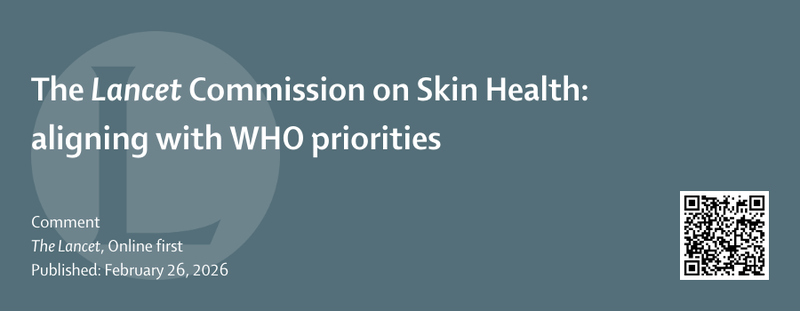
皮肤健康是人群健康的重要组成部分,近年来全球皮肤病疾病负担持续加剧。在第78届世界卫生大会上,皮肤病被列为全球公共卫生优先事项,这与实现全民健康覆盖的承诺相呼应。基于此,《柳叶刀》成立首个皮肤健康委员会(The Lancet Commission on Skin Health)。该委员会由中南大学湘雅医院牵头,联合全球多大洲顶尖皮肤病学科共同开展,是全球皮肤健康领域率先开展的高层次学术行动。中南大学湘雅医院陈翔教授、麻省总医院Esther E. Freeman 教授,以及伦敦卫生与热带医学院 Sinéad M. Langan 教授,担任委员会的共同主席。识别文中二维码或点击文末“阅读原文”,查阅评论原文。

图片


全球约有47亿至49亿人罹患皮肤疾病,皮肤病不仅是造成伤残生存年数(YLD)的主要病因之一,[1-3]而且在全球伤残调整寿命年(DALY)中也占到了1.79%[4]这表明皮肤健康是人群健康的重要组成部分,并非一个无关紧要的领域。

皮肤病种类繁多,涵盖约2000至3000种不同疾病,涉及健康及卫生体系的多个层面。其覆盖范畴既包括感染性皮肤病与非感染性皮肤疾病,亦涉及被忽视的热带皮肤病(NTDs)、疫情相关皮肤病、慢性炎症性疾病乃至皮肤肿瘤。尽管皮肤疾病谱如此广泛,据估计,仅有不到半数的患者能够获得合适的专科治疗[5]皮肤病的外在可见性,易引发社会污名及病耻感,进而造成深远的社会、心理与经济影响。在医疗可及性本就有限的情况下,会进一步制约皮肤病患者的就医行为。[6]

近几十年来,全球皮肤病疾病负担持续演变,非感染性皮肤病患病率日益增加,与既有的感染性疾病及被忽视的热带病负担相互叠加,共同加剧了疾病挑战。[7,8]这一疾病谱转变在人口结构、工业化和社会经济结构快速变迁的国家和地区中尤为突出,这些国家的卫生体系普遍存在专业人才匮乏、诊断能力薄弱和基本药物短缺等问题,难以有效应对新发的炎症性和恶性皮肤病。

尽管皮肤病在全球范围内的影响深远且日益加剧,但相对于其在全球疾病负担中的比重,相关资金投入仍严重不足,[9]皮肤疾病的研究在全球卫生的议题中长期处于边缘地位。[10]

在撒哈拉以南非洲、太平洋岛屿等偏远和医疗资源匮乏地区,健康不平等现象尤为突出。部分国家每百万人口中皮肤科医生不足1名,[11]甚至整个国家范围内找不到任何皮肤专科医师。承担一线诊疗工作的初级卫生工作者,则普遍未接受系统的皮肤病学培训,这致使这些国家地区的居民几乎无法获得任何专业的皮肤科医疗服务。

全球卫生政策框架已逐步认识到采用整合性策略应对皮肤疾病的重要性和必要性,世界卫生组织发布的《2021–2030年被忽视热带病路线图》即是范例。该路线图强调以初级保健为基础、多部门协作的模式,针对皮肤相关被忽视热带病的预防、诊断和管理设定了具体疾病目标。[12]

近年来,皮肤疾病面临的困境正在发生改变。2025年5月,在第78届世界卫生大会上,世界卫生组织成员国首次通过决议,将皮肤病列为全球公共卫生优先事项,这与实现全民健康覆盖的承诺相呼应。[13]该决议呼吁各国针对皮肤病的防治制定协同一致的国家战略,包括专科诊疗能力培训、减少社会污名化、相关健康政策倡导,以确保皮肤病诊断和基本药物的公平可及。

基于此,我们正式宣布成立首个《柳叶刀》皮肤健康委员会(The Lancet Commission on Skin Health)该委员会汇聚了皮肤病学、疾病负担、流行病学及实施科学等多领域的学者与专家,委员会覆盖世界卫生组织多个区域,涵盖高、中、低收入国家,并在领导层和作者构成上,注重性别平衡与区域覆盖平等。

本委员会将围绕一组相互关联的核心问题开展工作,主要聚焦三大领域。首先,各地区及生命全周期中,皮肤病的可预防、可干预负担究竟有多大?推动这些转变的关键驱动因素又是什么?其次,要加速实现皮肤健康领域的全民健康覆盖,包括加强社区健康教育、整合初级保健服务、完善转诊路径等方面,可设定哪些可量化的目标,以及应采用哪些实施模式?第三,全球范围而言,核心皮肤健康服务的基本包应包含哪些内容,方能涵盖预防、健康教育、即时诊断、基本药物可及性、数字医疗与远程皮肤病学服务,以及社会心理支持等关键领域?

在推进工作中,委员会将秉持公平理念,致力于减少社会污名,强化责任担当,并通过全球倡导与患者教育,提升患者话语权。我们将通过来自不同区域的典型案例,阐明重点挑战与应对策略,为因地制宜的实施提供差异化路径。

我们将通过典型案例研究进一步探讨皮肤健康领域的关键问题。首先,我们将全面分析工业化及其伴随的生活方式与环境变化对皮肤疾病谱的影响,探讨经济快速转型如何影响皮肤疾病的发生、进展和预后。其次,我们将绘制全球皮肤科人力资源分布图谱,揭示皮肤疾病的医疗服务可及性差异,梳理强化服务能力的新兴策略,如全球皮肤病诊疗任务分担、区域培训中心与创新人力模式等。第三,揭示同时面临感染性与非感染性皮肤病双重负担的国家的双重困境,总结其减轻皮肤相关被忽视热带疾病负担所取得的进展,揭示其面临的特有挑战。第四,将探索如何借助人工智能及其他数字工具和技术创新,改善黑素瘤和其他皮肤肿瘤的及时发现与管理。

委员会旨在发布一份综合性的报告与政策工具指南,并配套开展多地区学术活动及部长级圆桌会议。我们将与世界卫生组织、国际皮肤病联盟等合作伙伴及全球患者密切协作,确保科学、医学与政策协同共进,推动实现全民皮肤健康覆盖,让皮肤病诊疗服务不再是一种特权,而是人人享有的基本权利。END

团队介绍

《柳叶刀》皮肤健康委员会(The Lancet Commission on Skin Health)由中南大学湘雅医院牵头,联合全球多大洲顶尖皮肤病学科共同开展,是全球皮肤健康领域率先开展的高层次学术行动。中南大学湘雅医院陈翔教授,麻省总医院 Esther E. Freeman 教授、伦敦卫生与热带医学院 Sinéad M. Langan 教授担任委员会的共同主席。本文的通讯作者为中南大学湘雅医院陈翔教授,中南大学湘雅医院肖易主治医师为第一作者。

Declaration of interests

The Lancet Commission on Skin Health is supported by the Science Fund for Creative Research Groups of the National Natural Science Foundation of China (NSFC; grant 82221002), with funding awarded to and administered by XC’s institution. HWL is the President of the International League of Dermatological Societies (ILDS), and a co-author of this Commission; ILDS is a collaborating organisation on the Lancet Commission; HWL is also a board member of the CS Livingood Lectureship and Education Fund. EF, SML, and XC are the Co-Chairs of the Lancet Commission on Skin Health. EF reports grants to her institution from L’Oreal/CeraVe and the ILDS; royalties from UpToDate; consulting fees from L’Oreal; honoraria for academic lectures from the Chinese Dermatological Society, 2 the Society of Investigative Dermatology, MEIDAM, the New Jersey Allergy Society, GlobalSkin patient advocacy conference, the Australasian College of Dermatologists annual conference, and the International Congress of Dermatology; and is the Vice Chair of the International Foundation for Dermatology (unpaid), Section Editor of British Journal of Dermatology section on Global Health and Equity (paid), and Chair of the American Dermato Epidemiology Network (unpaid). SL reports grants to her institution from the UK Medical Research Council, the National Institute for Health and Care Research, the Wellcome Trust, the Canadian Institutes of Health Research, the Canadian Dermatology Foundation, Open Philanthropy, the US Department of Defense, the British Skin Foundation, and EU Horizon 2020 collaborations. VM reports grants to her institution from the National Health and Medical Research Council and the Australian Cancer Research Foundation; speaker fees from L’Oreal paid to her institution; advisory board participation with MSD, L’Oreal, and SkylineDx paid to her institution; and is a member of the Therapeutic Goods Administration Advisory Committee on Medicines and a board member of the Melanoma and Skin Cancer Trials Group (unpaid). AL is the Chair of Workstream 2-Roadmap for a National Targeted Skin Cancer Screening Program, Melanoma Institute of Australia and has been President and President-elect of the Australasian College of Dermatologists and Director of the Council of Presidents of Medical Colleges. SO reports travel support from WHO, the ILDS, and the Nigeria Centre for Disease Control for guideline development and global health meetings and is a member of the WHO Mpox Guideline Development Group on optimisation of standard of care and the Nigeria Centre for Disease Control (NCDC) Mpox Guideline Development Group and NCDC Mpox Technical Working Group and is Vice Chair of the WHO Skin NTD Working Group on Integration at Country Level (all unpaid). XC reports grants from the NSFC and the Ministry of Education of China and serves as a councillor of the International Psoriasis Council. YX reports grants from the Yale–China Association, the International Society for Atopic Dermatitis (ISAD), and the NSFC, and serves as a councillor of the International Psoriasis Council. AA, ND, NP, RB, and VA declare no competing interests. We thank The Lancet’s Asia Executive Editor Helena Wang and Lancet Skin Health Commissioners Group, including Ousmane Faye, Joel M Gelfand, Mohsen Naghavi, Liane Ong, and Zhengming Chen, for their substantive input and support during the development of this Comment and the broader Commission proposal.


References

[1] Yakupu A, Aimaier R, Yuan B, et al. The burden of skin and subcutaneous diseases: findings from the global burden of disease study 2019. Front Public Health 2023; 11: 1145513. 

[2] Leng M, Qi P, Li R, Gong F, Wei Z. Burden of immune-related skin diseases worldwide, 1991–2021: insights and prediction from the Global Burden of Disease Study. Front Immunol 2025; 16: 1668840.

[3] GBD 2021 Diseases and Injuries Collaborators. Global incidence, prevalence, years lived with disability (YLDs), disability-adjusted life-years (DALYs), and healthy life expectancy (HALE) for 371 diseases and injuries in 204 countries and territories and 811 subnational locations, 1990–2021: a systematic analysis for the Global Burden of Disease Study 2021. Lancet 2024; 403: 2133–61.

[4] Karimkhani C, Dellavalle RP, Coffeng LE, et al. Global skin disease morbidity and mortality: an update from the Global Burden of Disease Study 2013. JAMA Dermatol 2017; 153: 406–12.

[5] Freeman EE. Global health dermatology: an emerging field addressing the access to care crisis. Indian J Dermatol Venereol Leprol 2023; 90: 3–4. 

[6] GlobalSkin, the International League of Dermatological Societies. Skin diseases as a global public health priority: no UHC without skin health for all. 2024. https://globalskin.org/doclink/skin-diseases-as-a-global-public health-priority/eyJ0eXAiOiJKV1QiLCJhbGciOiJIUzI1NiJ9.dWIiOiJza2luLWRp c2Vhc2VzLWFzLWEtZ2xvYmFsLXB1YmxpYy1oZWFsdGgtcHJpb3JpdHkiLCJ pYXQiOjE3MTY0OTc4NzksImV4cCI6MTcxNjU4NDI3OX0.1VKfoy3Nd_ ZJMr-JI0uCV1cSSI41uCjrDjSrbdMmNk0 (accessed Dec 20, 2025).

[7] Wei J, Wang Y, Chen Y, et al. Global burden of psoriasis from 1990 to 2021 and potential factors: a systematic analysis. J Invest Dermatol 2025; published online Sept 8. https://doi.org/10.1016/j.jid.2025.08.038. 

[8] Huai P, Xing P, Yang Y, Kong Y, Zhang F. Global burden of skin and subcutaneous diseases: an update from the Global Burden of Disease Study 2021. Br J Dermatol 2025; 192: 1136–38.

[9]Hagstrom EL, Patel S, Karimkhani C, et al. Comparing cutaneous research funded by the US National Institutes of Health (NIH) with the US skin disease burden. J Am Acad Dermatol 2015; 73: 383–91.e1. 

[10] Yotsu RR, Fuller LC, Murdoch ME, et al. A global call for action to tackle skin-related neglected tropical diseases (skin NTDs) through integration: an ambitious step change. PLoS Negl Trop Dis 2023; 17: e0011357.

[11] Global Access to Skin Health Observatory Study. The Global Access to Skin Health Observatory Study. 2026. https://skinobservatory.org/ (accessed Feb 4, 2026). 

[12] WHO. Ending the neglect to attain the Sustainable Development Goals: a road map for neglected tropical diseases 2021–2030. Jan 28, 2021. https://www.who.int/publications/i/item/9789240010352 (accessed Dec 21, 2025). 

[13] WHO. Skin diseases as a global public health priority. Executive Board, 156th Session, 2025. https://apps.who.int/gb/ebwha/pdf_files/EB156/ B156_(24)-en.pdf (accessed Dec 20, 2025).


中文翻译由作者团队审阅,仅供参考,所有内容以英文原文为准。

https://doi.org/10.1016/ S0140-6736(26)00365-X
题图Credit: Courtesy of the International League of Dermatological Societies (ILDS)


推荐阅读

柳叶刀 | 中国科研崛起带来全球机遇
年度精选 | 2025《柳叶刀》中国作者研究
年度精选 | 2025柳叶刀重大报告

点击阅读原文,查看评论原文

关注柳叶刀服务号,探索更多科研服务!
#柳叶刀 #皮肤健康 #皮肤病 #柳叶刀委员会 #柳叶刀重大报告